Do you need a website if you sell clothes on Instagram?
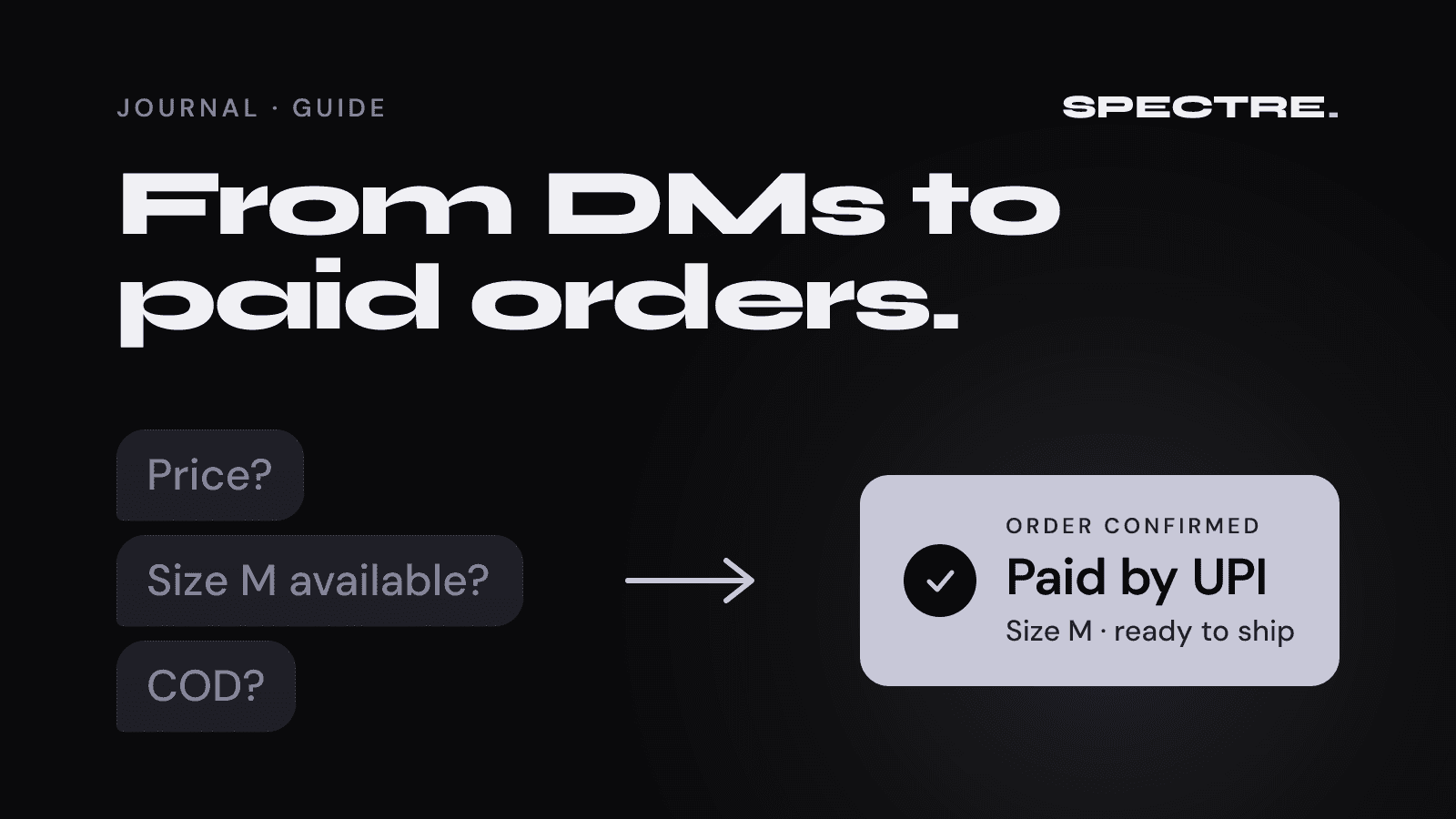
Short answer: not on day one, but probably sooner than you think. If you sell a few pieces a week and enjoy chatting with every customer, Instagram DMs are enough. Once you are answering the same "price?" and "size M available?" messages all day, checking UPI screenshots and losing money on cash-on-delivery parcels that come back, your own website starts paying for itself. It takes orders and payments while you sleep, makes paying upfront easy, and gives you a customer list that no algorithm change or account ban can take away. Keep Instagram for being discovered. Use a website for getting paid.
This guide is for small Indian brands that sell mainly through Instagram. We use clothing as the example, but the same applies to jewellery, accessories, home décor and home bakers. Every number below links to its source.
Why does Instagram alone stop working as you grow?
Instagram is the best shop window an Indian brand has ever had. Its ads can reach about 481 million people in India, 43.9% of all adults (DataReportal, Digital 2026: India). That is why so many clothing brands start there, and they should.
But Instagram was built for discovering things, not for running orders. It even removed its dedicated Shop tab in February 2023 to focus on Reels and content (TechRadar). So for most small brands, "selling on Instagram" really means selling through DMs, and DMs do not grow with you.
Here is the same order, done two ways:
| Step | In Instagram DMs | On your website |
|---|---|---|
| Price | Customer asks, you reply | On the product page |
| Sizes | You check stock and reply | In-stock sizes shown; sold-out ones can't be ordered |
| Payment | You send a UPI ID, then match their screenshot with your bank app | UPI or card at checkout, confirmed on its own |
| Address | Typed in chat, often missing a PIN code | A form that asks for every field |
| Records | Notebook, Excel or memory | Saved for you |
| Order update | You type it | Sent on its own |
| 2 a.m. order | Waits till you wake up. The buyer may not. | Goes through without you |
One order in DMs is fine. Fifty a day is a full-time job of copying, pasting and checking, before you have designed, packed or shipped anything.
What are the hidden costs of selling through DMs?
1. Your time
Every order needs you, personally, at every step. You cannot take a day off, and your brand cannot grow faster than you can type.
2. Cash-on-delivery orders that come back
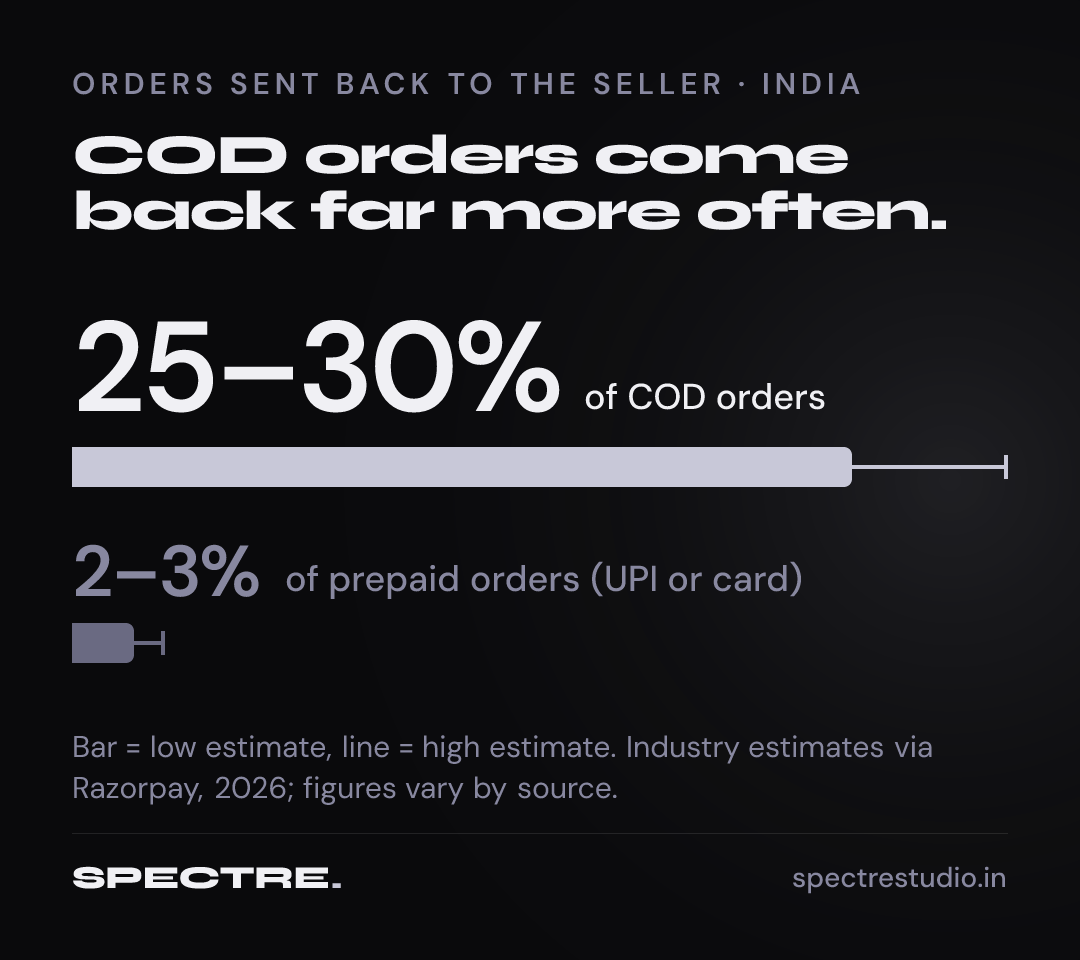
Many Indian shoppers still prefer to pay on delivery. ET Prime Research (2024) put cash on delivery (COD) at 60–65% of Indian e-commerce orders (via Razorpay). The trouble is what happens next. Industry estimates put the "return to origin" rate, meaning parcels that are refused or can't be delivered and come back to you, at about 25–30% for COD orders, against 2–3% for prepaid orders (Razorpay). The exact figures vary by source, but every source shows a large gap. On a parcel that comes back, you usually pay shipping both ways and earn nothing.
3. You are building on rented land
Your followers belong to your account, and your account lives by Meta's rules. From mid-2025, Instagram users and small businesses reported waves of wrongful account bans, with appeals often going unanswered (TechCrunch, June 2025). In June 2026, Meta's own Oversight Board said the way Meta disables accounts shows "a lack of transparency and consistency" (TechCrunch, June 2026). If your whole business lives in one account, one wrong ban can stop it overnight.
What changes when you have your own website?
Orders and payments without you
Paying by UPI is now a habit in India. UPI handled 85.5% of transactions on India's payment systems in the second half of 2025 (RBI data, via Free Press Journal). A website checkout lets a customer pay by UPI or card in seconds, at any hour, and you wake up to confirmed, paid orders.
More prepaid orders, fewer parcels coming back
When paying upfront is easy, more people do it. Across D2C brands on GoKwik's checkout network, prepaid orders rose from about 37% during Diwali 2024 to about 52% during Diwali 2025, "largely driven by UPI adoption" (GoKwik data). Your own website also lets you set your COD rules, for example COD only up to a certain order value, so you decide how much return risk you take.
Fewer repeated questions
A product page answers what DMs answer one by one: price, sizes in stock, a size chart, fabric, care, delivery time and your returns policy. Your DMs become real conversations instead of a price list.
A checkout people trust
A good website removes the reasons people give up at checkout. Among US shoppers who abandoned an order in Baymard Institute's survey, 40% left because of extra costs, 19% didn't trust the site with their card details, 18% didn't want to create an account and 17% found checkout too long or complicated (Baymard Institute). These are US numbers, but the lesson travels: show the full price early, keep checkout short, allow guest checkout and look trustworthy.
Speed that sells
Most customers who come from Instagram arrive on a phone, so speed matters. In a 2020 study of 30 million mobile sessions by Deloitte Digital and fifty-five, commissioned by Google, retail sites that got just 0.1 seconds faster saw conversions rise 8.4% (web.dev, Milliseconds make millions).
A customer list you own
Every order on your website gives you a customer's name, phone number and email. With their permission, you can tell past buyers about a new collection directly, instead of hoping the algorithm shows them your post.
Instagram and a website work best together
This is not Instagram versus a website. Instagram is where people find you; your website is where they buy. Keep posting reels, and put your website link in your bio, stories and highlights. A customer who loves a reel can go from "I want this" to "paid" in a few taps, without waiting for your reply.
When don't you need a website yet?
Honestly, not every brand needs one today. Stay with Instagram DMs for now if:
- You are still testing whether people want your designs.
- You get a few orders a week and enjoy talking to each customer.
- You don't yet have good product photos, fixed sizes or steady stock.
- Your money is better spent on stock than on a store right now.
You are ready for a website when:
- You answer the same questions all day.
- Orders arrive at night and some are gone by morning.
- COD returns are eating your profit.
- Losing your Instagram account would mean losing your business.
- You want to run ads that take people straight to a product and a checkout.
Store builder or custom website: which should you choose?
Once you decide on a website, there are two common routes. We use Shopify as the store-builder example because it is the best known; check current prices for any builder before you decide.
| Store builder (e.g. Shopify) | Custom-built website | |
|---|---|---|
| Upfront cost | Low. You can set it up yourself | A one-time build fee, based on scope |
| Monthly cost | Basic plan: ₹1,499 a month paid yearly, or ₹1,994 paid monthly, plus any paid apps | Hosting and upkeep, based on the setup |
| Extra fee per order | 2% on the Basic plan, on top of the payment gateway's fee | None. Only the payment gateway's fee |
| Time to go live | Days | Usually a few weeks |
| Design | A theme you customise | Designed around your brand |
| Who controls it | You, within Shopify's rules | You, if your contract hands over the code and domain |
| Best for | Starting fast on a small budget | Brands that want their own look and lower per-order costs as they grow |
Why the extra fee? Shopify's own payment system, Shopify Payments, is not available in India (Shopify Help Center). So every Indian Shopify store uses an outside payment gateway, such as Razorpay, and Shopify adds its own fee on top: 2% per order on Basic, 1% on Grow and 0.6% on Advanced (Shopify India pricing).
What that means on a ₹1,500 kurta
Razorpay's standard fee is 2% per payment, plus 18% GST on that fee (Razorpay pricing). For one ₹1,500 kurta paid by UPI:
| ₹1,500 kurta, paid by UPI | Shopify Basic | Your own website |
|---|---|---|
| Razorpay fee (2% + 18% GST) | ₹35.40 | ₹35.40 |
| Shopify's extra fee (2%) | ₹30.00 | ₹0 |
| Total fees | ₹65.40 | ₹35.40 |
That is about ₹30 more on every order. At 200 orders a month, that is around ₹6,000 a month, on top of the plan fee. (GST on Shopify's fee, if any, is not included.)
To be fair: a store builder is still the cheapest and fastest way to start. A custom website costs more upfront, so it makes sense when per-order fees and a brand that looks like no one else's start to matter more than the launch cost.
What does a good clothing-store website need?
Whoever builds yours, check for these:
- Fast on phones. Most of your Instagram customers arrive on a phone.
- A size chart on every product, in cm and inches, plus the size the model is wearing.
- Several real photos per product, including one on a person.
- Stock by size, so nobody orders a size you don't have.
- UPI and cards at checkout, with the full price, including shipping and any COD charge, shown before payment.
- Guest checkout. No forced account.
- Your own COD rules: on, off or limited.
- Automatic order confirmation and shipping updates.
- A clear returns and exchange policy page.
- A WhatsApp button for questions before buying.
- Your own domain (like yourbrand.in), so the brand is yours, not a platform's.
- Product names and descriptions as real text, so Google and AI search can find them.
How Spectre Studio builds this
Spectre Studio is a registered web design and development studio based in Thane district, Maharashtra, serving Mumbai, Thane and clients across India. We build custom on Next.js, not WordPress or page-builder templates, so your store is designed around your brand instead of a theme. You work directly with the founder, Girish Londhe, on strategy, design and build. No account managers, no handoffs. Most builds take 2–6 weeks from a confirmed brief.
Custom online stores start from ₹35,000. The final price depends on the size of your catalogue and what your store needs to do.
Every Spectre store includes:
- UPI and card payments through Razorpay or PhonePe.
- Stock tracked by size and variant, so sold-out sizes can't be ordered.
- COD rules you control, to cut the parcels that come back.
- An owner dashboard to manage your orders.
- Automatic shipping updates to customers by WhatsApp or SMS. The messaging service's charges are paid by you, in your own account.
- Full ownership of the code once the project is paid in full.
- 60 days of free fixes after launch, with an optional maintenance plan after that.
For a real example, see Aai's Puran Poli: a home kitchen in Pune that sold through word of mouth and re-typed WhatsApp chats. We built it a storefront that turns every visit into one structured, ready-to-fulfil WhatsApp order.
See what we have built on our work page, or tell us about your brand. We will give you an honest answer, even if that answer is "not yet".
Frequently asked questions
Can I sell clothes on Instagram without a website?
Yes. Many brands start that way, and it is the right choice while you are testing. It gets harder as orders grow, because every order needs you at every step.
How much does an e-commerce website cost in India?
A store builder like Shopify costs ₹1,499 a month on its Basic plan if you pay yearly, or ₹1,994 if you pay monthly, plus a 2% Shopify fee per order and your payment gateway's fee. A custom-built website has a one-time build fee that depends on scope, plus hosting and upkeep, and no platform fee per order. At Spectre Studio, custom online stores start from ₹35,000.
Will a website reduce my COD returns?
It can. Industry estimates put returns at about 25–30% of COD orders against 2–3% of prepaid ones, so every customer you move to UPI or card lowers your risk. A website makes paying upfront easy and lets you set your own COD rules. It will not remove returns completely.
Should a small clothing brand choose Shopify or a custom website?
Shopify, if you want to start fast with a standard store on a small budget. A custom website, if you want your own design and no platform fee on every order as you grow. Starting on a builder and moving to a custom site later is also a sensible path.
Do I still need Instagram if I have a website?
Yes. Instagram is where people discover you; the website is where they buy. They work best together.
What happens to my business if my Instagram account gets banned?
Without a website, you lose your shop window, your customer chats and your order history at once. With a website and a customer list, people can still find you, buy from you and hear about new collections while you appeal.
Sources
All prices and figures were checked on 14 October 2026.
- DataReportal: Digital 2026: India
- TechRadar: Instagram drops the Shop tab
- Razorpay: Cash on Delivery in India
- TechCrunch: Instagram users complain of mass bans (June 2025)
- TechCrunch: Meta's Oversight Board on account bans (June 2026)
- Free Press Journal: RBI report on UPI's share
- GoKwik Diwali 2025 data
- Baymard Institute: Cart abandonment rate
- web.dev: Milliseconds make millions
- Shopify Help Center: Shopify Payments countries
- Shopify: India pricing
- Razorpay: Pricing
Written by Girish Londhe, Spectre Studio.
All entries →