D'nova
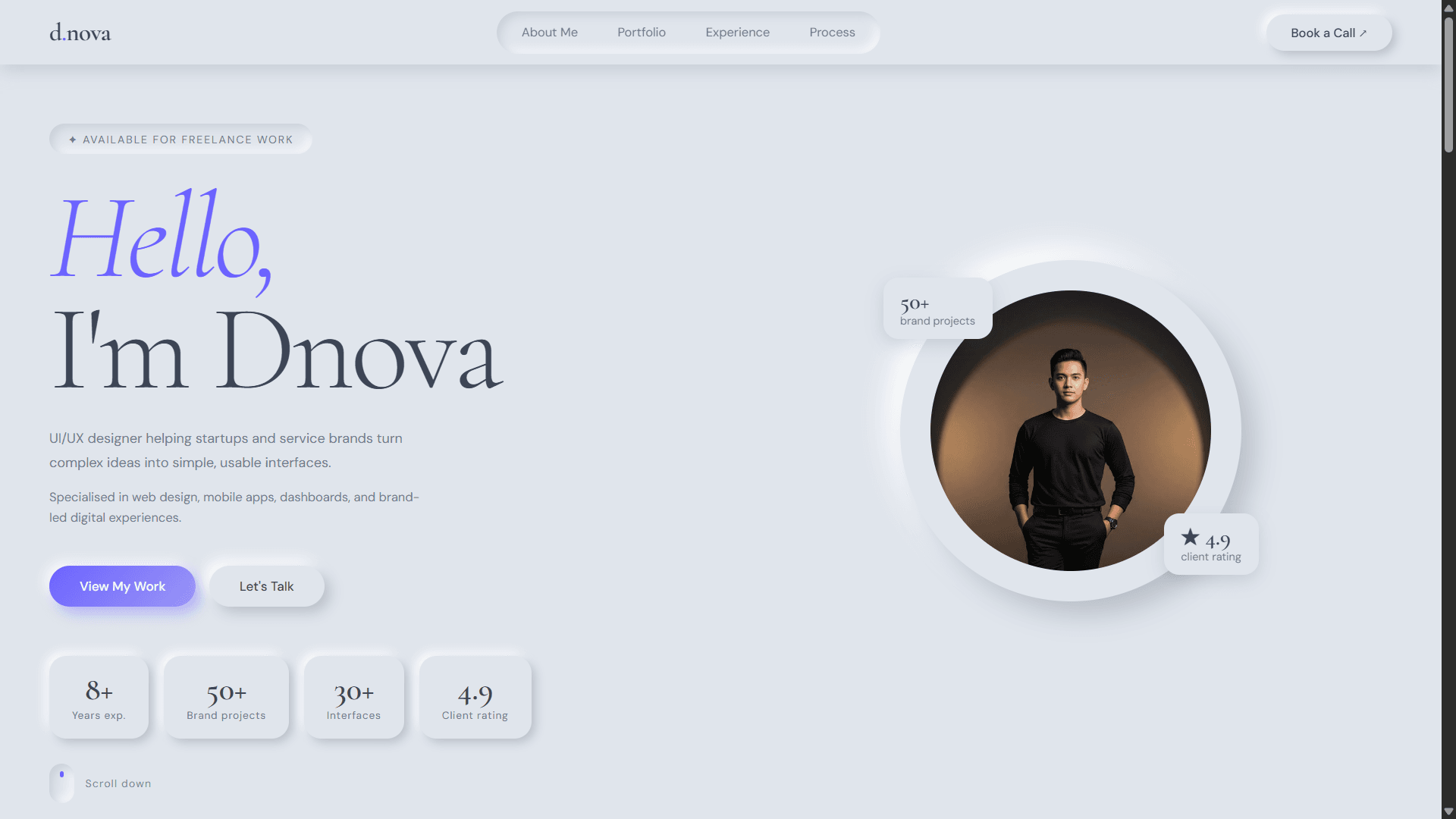
From a senior designer whose work was strong but whose portfolio wasn't — weak positioning, scattered proof, and no clear path to enquiry → to a premium personal-brand site that frames experience as authority and turns a visit into a booked call.
- Client
- Freelance UI/UX designer — personal brand
- Role
- Strategy · UX · Copy · Visual System · Front-end
- Scope
- One-page personal portfolio · positioning · credibility flow · enquiry conversion (email · phone · call booking)
The problem
A designer's work can be excellent and still lose the enquiry, because the portfolio has to do three jobs at once: prove credibility, stay minimal, and keep the focus on the work itself. D'nova needed to read as experienced, strategic, and easy to trust — without overloading the visitor or burying the path to getting in touch.
The content had to balance five competing pulls — personal branding, service clarity, portfolio proof, process explanation, and direct enquiry — in a layout that still felt restrained and modern. Too much, and it reads as insecure; too little, and there's no reason to book.
The approach
Structure the whole site as one credibility flow — each section answering the next question a serious prospect would ask — and let conversion ride alongside it instead of interrupting it.
- 01
State the positioning in the first screen
The hero says who he helps and how ("turning complex ideas into simple, usable interfaces") before any visual flourish, so intent is clear in seconds.
- 02
Prove it with contextual work, not just thumbnails
Selected projects carry role, category, and outcome, so each piece reads as a decision, not decoration.
- 03
Add an authority layer
Dedicated experience and process sections establish seniority and show how he works — which is what de-risks hiring a freelancer.
- 04
Convert without pressure
Repeated, low-key CTAs guide the visitor toward email, phone, or a booked call, so the next step is always one tap away but never pushy.
What we built
Positioning-led hero
Why
A portfolio that opens with decoration makes the visitor work to understand the offer.
What changed
The value proposition and audience are stated up front, immediately.
Context-rich portfolio cards
Why
Thumbnails prove taste but not judgment; clients hire for judgment.
What changed
Every project shows role, category, and outcome, turning the gallery into evidence.
Experience + process as a trust layer
Why
The biggest objection to a freelancer is reliability, not skill.
What changed
A clear track record and a defined working process answer that objection before the call.
Multiple low-pressure conversion paths
Why
Forcing one channel loses people who prefer another.
What changed
Email, phone, and call-booking sit throughout the flow, so intent converts wherever it forms.
What changed
Positioning
BeforeGeneric "designer" framing
AfterClear: helps startups & service brands turn complex ideas into simple interfaces
Proof
BeforeWork shown without context
AfterCards carry role, category, and outcome
Authority
BeforeNo visible track record or method
AfterExperience + process sections establish seniority
Conversion
BeforeNo obvious next step
AfterRepeated low-pressure CTAs → email, phone, or booked call
The result · Business outcome
Since launch, D'nova's site does the work a portfolio is supposed to do: it converts more inbound interest into real conversations and gives prospects a credible, professional presence to find before the first call. The positioning, proof, and process now carry the trust-building that previously fell on him to do manually in every conversation — so he walks into calls already established, not still proving himself. It validates the studio's thesis on a personal brand: that clear positioning and structured proof, not decoration, are what turn a viewer into a client.