Legal Chambers
From A solo Delhi advocate with no web presence — entirely dependent on referrals, with nothing a prospective client can see, read, or trust before picking up the phone → to A BCI Rule 36–compliant professional site that establishes credentials, sets honest expectations, and gives every prospective client a clear, low-pressure path to a consultation — before the first word is spoken.
- Client
- Solo advocate / legal practice
- Role
- Strategy · Compliance research · Copy · Design · Front-end
- Scope
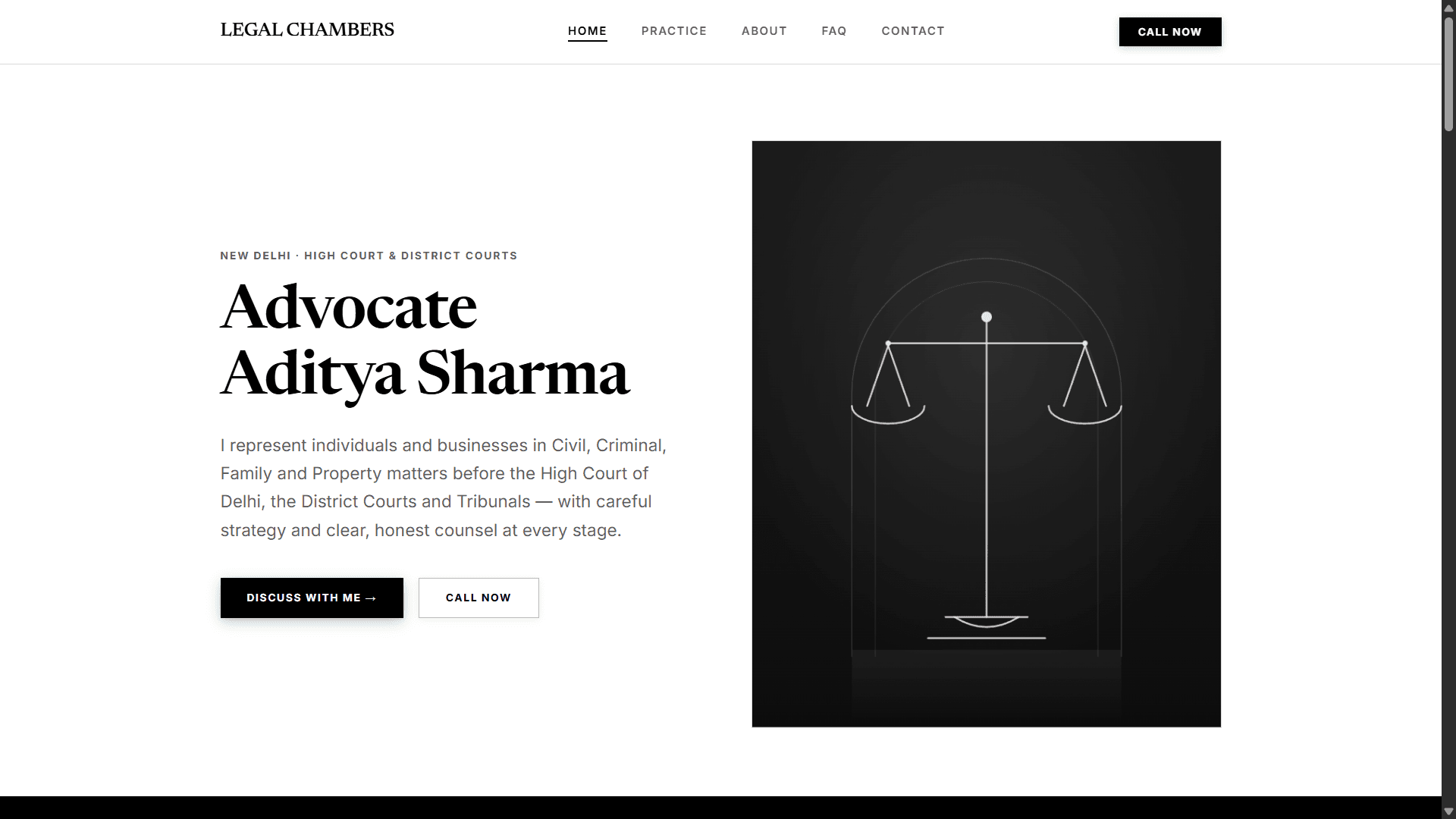
- One-page professional site · BCI Rule 36–compliant copy · practice area cards · "What to Expect" process section · FAQ · Call / WhatsApp / form consultation paths · SEO / OG / Attorney JSON-LD schema · self-hosted SVG art · full accessibility
- Timeline
- 1 week
The problem
A solo advocate needs a web presence — but the moment they go online, they risk violating Bar Council of India advertising rules that prohibit success rates, testimonials, and outcome claims. They have to earn a stranger's trust using only the facts they're allowed to state.
Most advocate websites ignore BCI Rule 36 entirely: they publish "500+cases won," client testimonials, and guarantee-adjacent language that the rules explicitly prohibit. The brief here was harder — earn a prospective client's trust without any of those tools. Only permissible facts were available: years at the bar, enrolment number, courts appeared in, and practice areas. The site had to convert on those alone.
The approach
If you can't claim outcomes, lead with process. Replace prohibited social proof with three things a prospect genuinely needs before they call: verified credentials, honest practice area scope, and a transparent account of what working with this advocate actually looks like.
- 01
Map the compliance boundary first
BCI Rule 36 prohibits solicitation, outcome advertising, success statistics, and client testimonials. Every design and copy decision downstream of this is shaped by what it allows: verified facts, practice scope, court appearances, and process transparency. Getting the boundary wrong would expose a real advocate to professional sanction.
- 02
Replace prohibited proof with permitted credibility
No testimonials. No win-rate. Instead: enrolment number and year (verifiable at the Bar Council), LL.B. qualification and institution, courts appeared in, and 15 years at the bar — stated plainly, not inflated. These are facts a prospect can check, which makes them more trustworthy than a claim they can't.
- 03
Build trust through process, not promises
The "What to Expect" section does the job testimonials normally do — it tells a prospect exactly how this advocate works: honest assessment first, then a tailored strategy in plain language, then protected, informed progress. No outcome promises. Three steps that answer the question every first-time legal client actually has: what will this be like?
- 04
Make the consultation path as low-friction as possible
A prospective legal client is already anxious. The path from "I need a lawyer" to "I've made contact" should have no unnecessary steps. Direct call CTA in the nav, WhatsApp deep-links pre-loaded with a starter message, a contact form with practice-area pre-fill from each practice card, and a mobile sticky bar — every route works on whatever device and channel the prospect is already on.
What we built
BCI Rule 36 compliance by design, not by accident
Why
Most advocate sites run prohibited content because designers don't know the rules. A real advocate publishing a non-complaint site risks professional sanction from the Bar Council of India.
What changed
Success statistics, testimonials, and outcome language removed entirely. Every copy line was cleared against Rule 36 before it went on the page. A statutory disclosure modal appears on first visit and a persistent footer disclaimer maintains compliance throughout.
"What to Expect" replaces the testimonials section
Why
Testimonials are prohibited. But the job they do - helping prospect understand what it feels like to work with this advocate - still needs doing. Skipping it leaves a trust gap.
What changed
A three-step process section (Honest Assessment -> Considered Strategy -> Protected & Informed) tells the prospective client exactly what the engagement looks like, without making any promises about results.
Credential block, not a vanity bio
Why
Advocates are verified professionals. The most credible thing this site can show a stranger is verifiable fact - an enrolment number they can site look up, a court they can confirm, a year they can count from.
What changed
A structured credentials grid - qualification, enrolment, number, courts appeared before, languages - placed in the About section alongside the advocate's photo. No inflated biography. Verifiable over impressive.
Three parallel consultation paths: Call · WhatsApp · Form
Why
Legal anxiety is real. A prospect who isn't ready to call should still be able to reach out. A prospect who found the site at 11pm should have a path that works then.
What changed
Direct call link in the nav and hero. WhatsApp deep-links pre-loaded with a starter message. A contact form with practice-area pre-fill triggered from each practice card. A mobile sticky bar (Call + WhatsApp) that appears only after the hero scrolls out - present everywhere the prospect might stall, absent when it would just be noise.
What changed
Online presence
BeforeNone - referrals and word of mouth only
AfterA professional site that works as a first impression before any conversation
Trust signals
BeforeTrust built only once you get them on the phone
AfterCredentials, process transparency, and FAQ establish credibility before first contact
Compliance
BeforeRisk of BCI Rule 36 violation the moment any marketing claim goes online
AfterFully compliant - no prohibited content, statutory disclosure modal, persistent footer disclaimer
Consultation path
BeforeUnclear - "find the number somehow, then call"
AfterThree parallel paths (Call · WhatsApp · Form), each available from multiple points on the page
Mobile experience
BeforeVery poor
AfterSticky CTA bar (Call + WhatsApp) appears after hero exits - always reachable, never intrusive
The result · Business outcome
A fully deployed, BCI-compliant site that positions the advocate as credible and approachable — built on permitted facts and process transparency rather than inflated claims. It proves the studio's thesis: that rigorous strategy within real constraints, not decoration or fabricated proof, is what builds professional trust online.